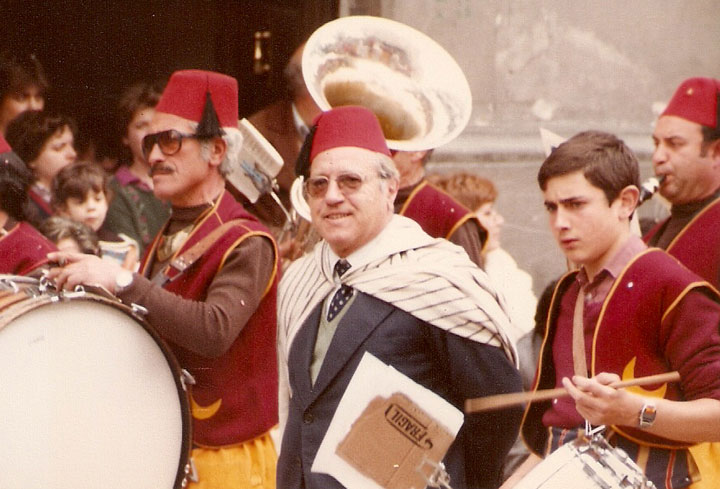

Biography
Mestre Ferrero
José María Ferrero Pastor (Ontinyent, 1926 – 1987)
A key figure in 20th-century Valencian music. A composer, conductor, and music educator, his legacy has transformed the music for the Moors and Christians festivals.
José María Ferrero Pastor was born in Ontinyent (Valencia) on December 21, 1926. The son of an amateur musician—owner of a family business and a horn player in the Unión Musical band—he inherited his love of music and his first lessons in solfège from his father.
Musical Training
At the age of nine, he formally began his musical studies, attending solfège classes at the Unión Musical (Musical Union) taught by Professor Benito Rodrigues. He quickly distinguished himself for his musical talent and began his instrumental training with the alto horn, although his initial vocation was to be a trumpet player. Circumstances at the time and the band’s needs led him to change instruments, joining the band—then called F.E.T. y de las JONS—in 1940, first as an alto horn player and later as a horn player, an instrument he would come to master completely.
He expanded his theoretical studies under the direction of Miguel Asensi, the band’s director at that time, and later under the tutelage of Reverend Father Vicente Pérez-Jorge, who would become his true teacher and musical mentor. With him, he studied piano, harmony, counterpoint, and composition. He validated his studies in composition and instrumentation at the conservatories of Valencia and Seville, obtaining an outstanding grade as his final mark.
Early Years in Composition, Conducting, and Music Teaching
In 1945, he prepared for the French horn auditions in the Band of the General Air Academy of San Javier. However, both his father and his teacher, Pérez-Jorge, convinced him to focus his future on conducting and teaching music in his hometown, an objective that perfectly aligned with Ferrero’s deep local pride.
That same year, at just 19 years old, he composed his first pasodoble, “Onteniente,” a work that foreshadowed the strong bond he would always maintain with his city. In 1946, he composed the waltz “Tonín,” dedicated to his first nephew.
In 1947, he was stationed in Valencia to complete his military service. During this period, with the support of Ramón Corell, director of the Unión Artística Musical Band, he regularly attended rehearsals of the Valencia Municipal Orchestra, where he gained his first experience in conducting. During these years he composed the pasodobles Morell Seguí, dedicated to his parents, and Ricofran, dedicated to his three best friends from his military service.
Upon his return to Ontinyent, he joined the band as an assistant, teaching solfège to the students, a task he considered essential and which would definitively shape his pedagogical vocation. He declined offers to conduct bands in other towns, dedicating all his efforts to the local music society.
The musical training of future musicians was always one of his highest priorities. From a very early age, he fought to secure, with the support of local authorities, a suitable space for the development of musical education, a concern he maintained until the end of his life.
The Consolidation of His Role as a Composer and the Success of Chimo
The 1960s marked the golden age of José María Ferrero’s career, both as a conductor and composer. In 1960, he composed three pasodobles and a Moorish march. Among them, the pasodoble “Daniel Juan” stands out, written on the night his infant son died from an illness.
However, the pinnacle of his career came in 1964 with the composition of the Moorish march “Chimo,” which achieved immediate and lasting success, becoming the true anthem of the Moors and Christians festival. Its simultaneous performance by the various bands participating in numerous festival events has established it as one of the most emblematic and frequently performed works in the festival repertoire.
During this decade, he received the following awards: first prize at the Alcoy Festival of Festive Music in 1961 with the Moorish march “El Berberisch,” in 1965 with “El Kábila,” and in 1971 with “Bon Capitá.” In 1966, he won second prize with the Christian march “Bonus Christianus.”
The 1965 prize, awarded by popular vote, was particularly significant: of the 931 votes cast, 910 were for “El Kábila,” reflecting his extraordinary connection with the public.
Recordings and Dissemination of Festival Music
He was a pioneer in recording music for Moors and Christians festivals. In 1960, he released his first single, recorded in Madrid by a concert band conducted by Maestro Ricardo Vidal, dedicated exclusively to Moorish marches. In 1961, he released a second single with pasodobles and Moorish marches.
In 1970, he recorded the LP “Los moros y cristianos del maestro Ferrero” (The Moors and Christians of Maestro Ferrero), which included, among other works, the Moorish march “Chimo.” This discography was completed in 1984 with a second LP and the single “Protagonistas de la fiesta” (Protagonists of the Festival).
Dedicated to Festivals and Altruistic Work
He was deeply involved in the world of festivals. He founded the Mozárabes troupe in 1948 and the Saudias troupe in 1966. He always championed the recognition of festival music and the performing musician. His dedication to music, both creatively and as a teacher, was entirely altruistic.
He combined his musical life with a small business manufacturing and distributing soft drinks, his family, his hometown (Ontinyent), which he always proudly represented, and especially its festivals. For this reason, he was highly regarded in the social circles he frequented, and in 1967 he was awarded the Medal of Merit for Festivals by the Ontinyent Festival Society.
Proof of his altruism was the fact that, through the composition of the pasodoble “Cervezas El Turia,” he managed to get the aforementioned brand to pay for the band’s new uniforms instead of receiving any amount for the aforementioned pasodoble.
Final Years and Legacy
In the 1970s, at the height of his musical and personal powers, and with the encouragement of his teacher Pérez-Jorge, he saw one of his greatest dreams fulfilled: the 1975 inauguration of the José Melchor Gomis Music Center—later the Professional Conservatory—which opened access to formal music education for the entire region.
In 1972, he premiered his masterpiece, the symphonic poem “Els Morocristians d’Ontinyent” (The Moors and Christians of Ontinyent), in which he recreates the conquest and reconquest of the town. Once again, we see José María Ferrero as a scholar and avant-garde artist, as he was a pioneer in exploring this musical style with festive themes.
During these years he received further awards, including the first prize for composition from Caja del Sureste in Alicante (1974) for the Moorish march “Marroquíes de Petrer,” and several second prizes in Alcoy for the pasodoble “Imposibles” in 1976 and the Christian march “Apóstol Poeta” in 1978.
His innovative spirit led him to compose the Moorish march “OVANA” for the First National Congress of the Moors and Christians Festival (Villena, 1974), a work that broke with the traditional harmonic structures of the genre.
In 1976 he joined the board of UNDEF as a member and musical advisor. He was one of the organizers of the First Centenary of Festival Music (1982) and a promoter and organizer of the Second National Congress of the Moors and Christians Festival held in Ontinyent in 1985, where he served as vice president.
For this second congress, a gala concert was organized, performed by the Valencia Municipal Band, featuring the premieres of five symphonic compositions and a pasodoble, all based on themes from the Moors and Christians festival. These works were composed by renowned composers such as Bernardo Adam Ferrero, Luis Blanes, Rafael Talens, Rafael Alcaraz, and Bernabé Sanchis, and included the premiere of José María Ferrero’s second symphonic poem, “Fantasía Muladiana.”
In August 1982, he premiered the funeral march “Cristo de la Agonía,” dedicated to the patron saint of Ontinyent.
Death and posthumous honours
José María Ferrero died on 26 July 1987 in a road traffic accident. Since his death, he has received countless tributes and honours over the years, which bear witness to his indelible impact. Among others, these include: the Gold Badge of the Society of Festeros (1987), the title of Favourite Son of Ontinyent (1987), the title of Honorary Festero with the Gold Badge from the UNDEF (1988), the Gold Medal from the Alicante Provincial Council (1988), the designation of the Moorish march ‘Chimo’ as the Official Anthem of the Moors and Christians Festival in Ontinyent (2014), and the posthumous award of the title of Distinguished Figure of Valencian Music by the Valencian Academy of Music (2015).
The Sociedad Unión Artística Musical, to which he dedicated his entire life, appointed him Honorary Director with the Gold Insignia and named its music school after him as the “Mestre Ferrero” School of Music, thus perpetuating his musical and human legacy.